The History of the West Mersea Inshore Lifeboat Station
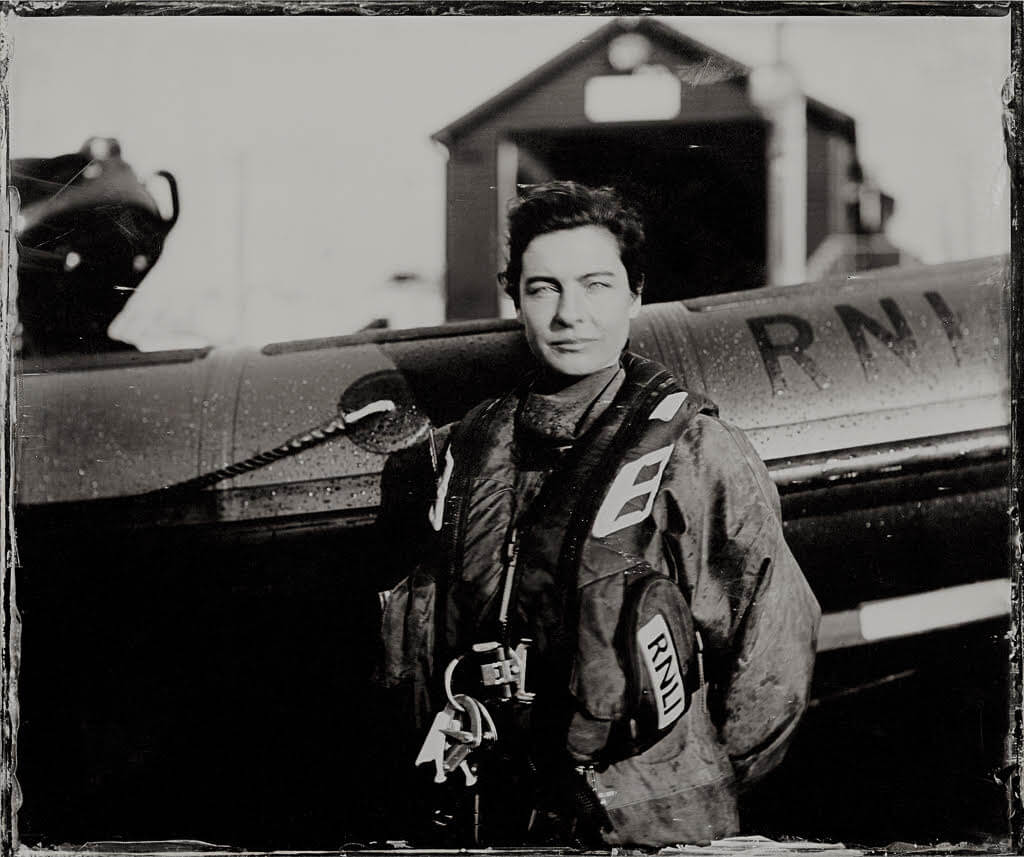

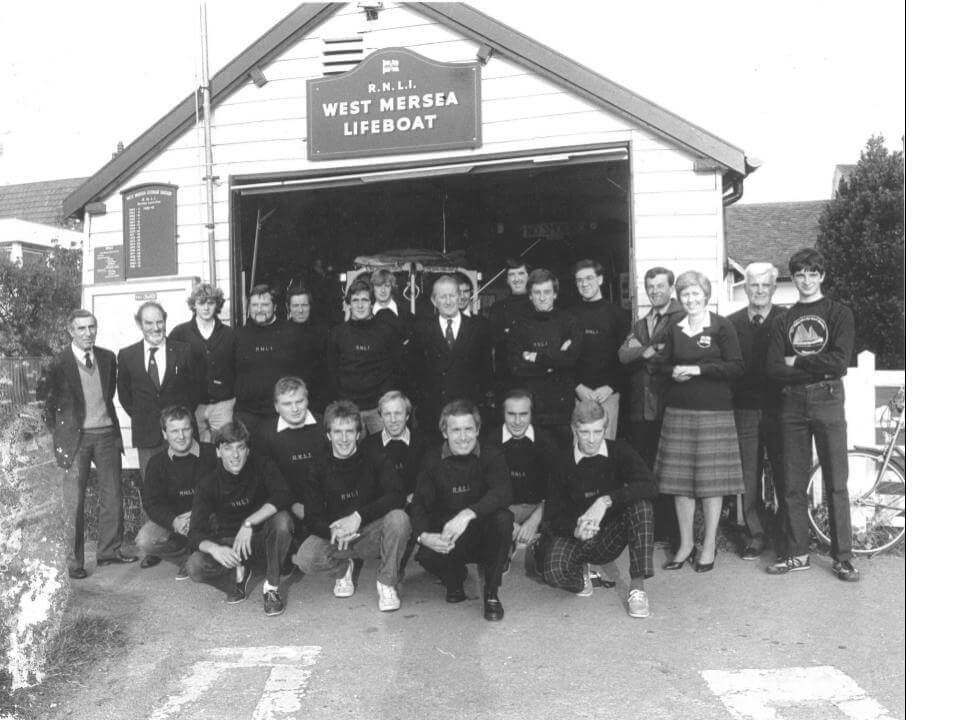
[ Extract from Tony Purnell’s “Four Minutes to Launch” – The story of the West Mersea Lifeboat Station ]
Foreword
Much of the strength of the lifeboat service of Britain and Ireland derives from local pride and local autonomy. Not only is the service a voluntary one, supported entirely by voluntary contributions, but its stations are themselves largely independent units. They are administered locally with only policy and financial control by the RNLI’s Committee of Management, and their crews are formed of local volunteers.
Partly for this reason, and even more because of the nature of the self-imposed humanitarian tasks, towns and villages which have lifeboat stations always take a great pride in them.
One expression of this pride is the local publication in increasing numbers of station histories. Some station histories extend for more than a century and a half. They contain inspiring stories of courage and endurance, indicating what men, supported by women, will do when others are in danger at sea. They are also a valuable source of material for social historians.
This new history of the West Mersea lifeboat station is unusual in that the station was established only recently. It is no less valuable for this reason. In a number of places our knowledge of the early years of the work of the lifeboat is sketchy and few records remain. The interesting question of how they came into being may perhaps never be answered.
The author has ensured that no gap will exist in the history of the West Mersea station, which has already achieved much and which will no doubt have a distinguished record in the future.
PATRICK HOWARTH
Public Relations Officer RNLI
Atlantic 21 Inshore Lifeboat
West Mersea Station has an Atlantic 21 Inshore Lifeboat developed by the RNLI from a design originated at Atlantic College, South Wales, in the late 1960s. The RNLI was seeking increased speed, easier handling, and greater range in its inshore lifeboat fleet, and the Atlantic 21 possessed these qualities. The fitting of navigation lights and VHF radio with a communications range of at least ten miles has produced the additional asset of a night capability.
This ILB is semi-inflatable, the rigid hull being made of glass reinforced plastic, subdivided into watertight compartments. The hulls are made by Halmatic Ltd. of Havant, and the fitting of the inflatable tubes, engines, steering, self-righting gear and other equipment is carried out at the RNLI‘s ILB base at East Cowes, Isle of Wight.
The crew of three are seated on a console unit which contains radio, compass, controls, batteries and other equipment. In the event of the Atlantic 21 being capsized, a crew member activates a gas bottle which rapidly inflates the bag on the roll-bar assembly above the engines. Within a few seconds, the boat rolls upright and the engines may be re-started.
Overall Length — 22′ 9″
Overall Beam — 7′ 6″
Length of Hull — 19′ 4″
Displacement — 2250 lbs.
Draught (at rest) — 2’6″
Engines — Twin 50 h.p.
Speed — 29 knots
Radius of Action — 50 miles
Introduction
After a certain uncomfortable personal experience in my own boat some years ago, I joined the RNLI as a member of the Yachtsmen’s Lifeboat Supporters Association (now Shoreline). I then joined the Maldon (Essex) Financial Branch – not far from West Mersea and at the head of our River Blackwater. This branch has close associations with the West Mersea Inshore Lifeboat Station and the ILB used to visit us about once a year and both boat and crew were extremely popular. In 1977 we moved to West Mersea and it was my privilege to be asked to help the Station, both on the operational and fund raising sides.
As a newcomer to West Mersea, it was with some trepidation that I approached the Hon. Sec. and Station Committee to see if they would agree to my attempt to produce a booklet on the history of the Station, especially on the operational side, but not forgetting the fund raisers and supporters. I was most grateful for their friendly and co-operative reaction, especially as I felt that we would have a permanent record for posterity, and the sons and grandsons of our present crews would be able to tell their children how the West Mersea ILB Station and its supporters did their work from 1963 to 1979.
I am bound to forget somebody, but the support and encouragement that I have received from everybody has been most gratifying and indeed stimulating. I must particularly thank Albert Clarke, Jim Clarke and his wife Lilian, and Diggle Haward and Peter French,. who were virtually all involved in the Station right from the beginning. A local Press appeal gave me information from many sources, and there were of course the Station Minute Books passed to me by Lt. Commander Maurice Bond, R.N.R., currently Hon. Secretary, and the Minute Books from both the old Financial Branch and the Mersea Island and District Ladies’ Guild. In addition, our H.Q. at Poole gave their usual full support.
I would like to thank Laurie Knott who so very kindly risked his dictating machine from his office to me at weekends with the dire possibility that he might not be able to write any letters the following week, to Kelly Ward who cheerfully put up with my awful dictation and indecipherable notes in longhand, to Brigadier Jack Ellison, C.B.E. , who donated the delightful drawing, to our advertisers who donated so generously, to Roy Farthing who has printed this book and provided the photographs, and to my wife Joan who read the proof and is herself a keen RNLI supporter.
Tony Purnell
W. Mersea
August 1979
The Story of West Mersea Inshore Lifeboat Station
Dedicated to the crews, past and present of the West Mersea ILB
Way back in 1960/61, Diggle Haward, well-known local yachtsman and former Commodore of the Wivenhoe and the Dabchicks Sailing Clubs, decided that owing to the boating boom and the consequent increasing number of pleasure boats on the Blackwater Estuary, “something should be done about it”.
In those days the RNLI was doing a great deal of research as regards fast inshore rescue boats, but there seemed very little possibility of getting one here, and Diggle called a meeting of local people with an idea of starting a Mersea Rescue Service. There were several boats involved among them Magia (F. M. Haward), the Dabchicks Sailing Club Rescue Launch and the Launch from the West Mersea Yacht Club. There were no radios and for two years the service operated on a very amateur but extremely keen and successful basis in close liaison with the police, who actually called them out for assistance.
Unfortunately, records are not available but although there were some very humorous incidents, the Mersea Rescue Service did an excellent job and gave an indication of the spirit that was to form the basis for the new RNLI Station.
In 1962 Diggle Haward on his own initiative approached RNLI H.Q. with a possibility of having an IRB (Inshore Rescue Boat as they were known in those days) and Lt. E. D. Stogdon, M.B.E. R.N.V.R., a member of the H.Q. Operational and Technical staff of the RNLI came and brought a demonstration 16′ ‘D’ type inflatable inshore rescue boat for everybody to have a look at. There was a report back to H.Q. and Diggle was asked to form a Station Committee for the establishment of an Inshore Rescue Boat Station of the RNLI at West Mersea, which would be operational during daylight hours only and during the summer months from approximately lst April to 30th October.
This was indeed progress and Diggle Haward himself became the first Hon. Sec. of the Station Committee, the Chairman being Mr. B. Rainbird. As far as records are available, the first volunteer crews were:
A. Clarke
A. Muir
B. Reed
P. Clarke
P. French
P. Mead
J. Clarke
D. Stoker
D. Haward
C. Milgate
By kind permission of Clarke & Carters Boatyard, the IRB was kept in the open on a trolley immediately in front of their forecourt, and on the other side of the road. In those days, fortunately vandalism was not quite the problem that it is now and the boat suffered very little, although I am told that occasionally there was a certain amount of “floppiness” in the inflatable sponsons and a great deal of surplus energy was used on pumping her up. However, the important thing is that the boat was maintained and never was there any question of anything going wrong when she was called for service.
Exercises were carried out frequently and the then Hon. Sec. himself volunteered the information that he used to go overboard to “let the boys have some training in picking somebody out of the water”. I will not go into the gruesome details but I believe on one occasion, when they yanked Diggle back aboard, very tender parts of his anatomy came into contact with the projections on the side of the IRB and for some time, that particular crew were very much out of favour with our Hon. Sec!
The amazing thing is that right from the start, as is customary at most Lifeboat Stations, maroons were used to call out crews for service, and these were fired from West Mersea Yacht Club after notification from the Coastguard that RNLI services were required. But unfortunately, this procedure met with a considerable amount of local opposition because of the noise, although the boat was operational during daylight hours in summer only! All this of course was understandable, but common sense eventually prevailed, especially when it was realised what a tremendous service the IRB crew were doing and they were in existence solely to save lives.
It is hard to realise that in those early days the IRB was not equipped with radio and once the Coastguard called them out, they had no means of communication apart from telephoning (difficult off the Bench Head!).
There was at least one occasion when, during a search off Colne Point, Albert Clarke and Peter French both then crewmen, took the boat ashore and walked up to the telephone booth to enquire from the Coastguard whether or not they should continue a certain search! From the record book, there are obviously occasions when a lot of fruitless time and energy were spent on exhausting searches which resulted in “nothing to report” or called off by the Coastguard because people concerned had eventually got ashore safely.
This little IRB was no fun in heavy weather, the crew were very much exposed even though she was restricted to “summer service” only, although I know that there were many occasions when she was quietly launched (incidentally without the maroons!) to effect a rescue after dark.
Although the date is not quite certain, after about two years, the Station was re-equipped with a Zodiac Inflatable, and once again due to the increase in boating and consequent public interest, the B.B.C. came down and produced a small documentary and what is even more important, our local Council became interested when they realised that the boat and its volunteer crew were an integral part of the emergency services, just as much as the ambulance and fire services.
At this stage, Paddy Hare, well-known Managing Director of Gowans, the sail makers, and local yachtsman, offered the RNLI the use of a shed (formerly used as a store by the Army Sailing Association) as a boathouse. This offer the RNLI gratefully accepted and before they moved in, Paddy arranged for the concrete floor to be put in and Vernon Powell another well- known member of the local sailing fraternity, provided the portable ramp to enable the boat trolley to be wheeled out across the road prior to launching.
Local teamwork support came to our assistance again and a radio for the Zodiac was provided from a special fund raising project by the Station throughout the area. At this stage, it is very important to remember that local financial support and fund raising efforts were steadily increasing, not only for this Station but for the RNLI in its entirety. Although this is mainly an operational history , the boat could not have been in existence without this support, and later on in these notes you will find further details of the good people who gave so much and so readily, for essential back-up support for our local Lifeboat Service.
In 1971 – and I am sure this was due to not only the increasing number of services and the excellent service record, but to local pressure as well – the RNLI decided to station one of the new Atlantic 21 Inshore Lifeboats at West Mersea, on a fully operational basis, i.e. 24 hours call, night and day, summer and winter.
In fact I believe that this was one of the first three to go on full service, immediately closely followed by one at Southwold. (In fact, our colleagues at Southwold reckon that we pinched their boat, having jumped the gun on the order list!) The Atlantic 21 was presented to the Lifeboat Service by Alexander Duckham & Co., well-known oil manufacturers, and there is an historical record of this in the boathouse. In 1967, due to pressure of work, Diggle Haward the Hon. Sec. had to relinquish his position and became Chairman, and his post was taken by Lt. Commander Maurice Bond, R.N.R., who still remains as Hon. Sec., and Senior Launching Authority.
When the Alexander Duckham was first launched, there was much local press coverage, jollifications, visitations by “top brass” from the Committee of Management and various “trips ” by august personages, including our local M.P. It should be remembered that for a long time, Mersea Island Fund Raising activities were controlled from the Colchester Financial Branch, but with their co-operation the West Mersea Station and its ancillary fund raising organisations, became autonomous.
Now unfortunately, there does seem to be some slight discrepancy between some of the records, and if anybody has inadvertently been omitted, I trust that I shall be forgiven and that my beer ration will not immediately cease!
Launching Authorities were as follows:
Maurice Bond
Diggle Haward
Harry Place
Albert Clarke
Peter French
Honorary Medical Adviser – Dr. Grant
Although the maroons were still fired, and are, at the W.M.Y.C. on request, all the deputy Launching Authorities could do this, but as Albert Clarke was almost always at his workshop on the Coast Road immediately adjacent to the Causeway, he seemed to do it about 60% of the time!
By now the number of successful services as compared with the total number of calls, had fully justified the RNLI decision to station the Atlantic 21 here, and in fact, we were becoming one of the busiest ILB stations on the East Coast. A trend that has continued to the current day….
Having covered the early history of the operational side as far as possible within space limitations there are other aspects which make very interesting reading and one in particular, was the invitation to Jim Clarke and his wife to represent the Station and the crew at the Royal Garden Party at Buckingham Palace on Thursday 26th July 1973. I know that it was an event which Jim and Lilian will never forget, and indeed, is a great honour for West Mersea ILB Station.
To celebrate the 150 years of the RNLI, a large party were invited to a Garden Party at Buckingham Palace to represent the Station, Financial Branch and Ladies’ Guild. I understand they included amongst others: Mr. and Mrs. P. French; Mr. and Mrs. J. Frost; Mr. and Mrs. A. French; Mr. and Mrs. D. Mills; Lt. Cmdr. and Mrs. M. Bond and Mr. D. Haward.
Mention without doubt must be made of the excellent relationship that this Station has with H.M. Coastguard at Bradwell and at Thames, and with the crews of the R.A.F. Rescue Helicopters. Both on exercises – of which there are many – and on operations, the co- operation has been first class and the professional expertise of our full time colleagues is very much appreciated. Neither must we forget the adjoining Stations – Clacton with its off-shore boat and ‘D’ type ILB and also Burnham-on-Crouch with its similar ILB.
Fund Raising
Now lets have a look at the fund raising efforts by local people. From the inception of the Station, certain people with pride and foresight decided that money should be raised locally to support “Our Island Lifeboat”. Here again, I may have left some people out, but in the records there is evidence of excellent team work and a very fine spirit.
Right at the start, West Mersea Yacht Club lent a hand both financially and giving support in other directions, e.g. the Launching Authorities and crews were made honorary members of the club and this privilege was honoured very much in spirit, and not just in letter! It did of course, assist in that most of the Station Committee were members of the W.M.Y.C., or the Dabchicks S.C., and this helped a tremendous amount. Two local boatyards, Clark & Carter Ltd., and William Wyatt Ltd., did things quietly behind the scenes with very little publicity – for example, Clark & Carter Ltd., lent the station an electric winch for hauling out.
Station members – both Committee and crews – had done their own fund raising for the RNLI in addition to running the station operationally. But eventually it was decided to organise a separate fund raising branch, and on 9th January 1973, a special meeting was held at the West Mersea Yacht Club under the Chairmanship of George Price, Eastern District Organising Secretary to inaugurate the Mersea Island District Financial Branch.
Working in close co-operation with the Financial Branch, the Ladies’ Guild went from strength to strength organising fund raising events in most months throughout the year. Some of the highlights were in the dances at Coopers Beach, seafood evenings, Christmas floats and fashion shows. In 1978 they organised the first sponsored row. These functions, apart from being very successful fund raising efforts were very much enjoyed locally and have now become well established annual events.
I must mention here (at the risk of being shot at as a M.C.P.) that the Committee of the Financial Branch seemed to be predominantly “male persons” although two members of the Ladies’ Guild were also Financial Branch Committee members to keep the close co-operation going. Rumour has it that they were in fact, there to keep the men in order! Nevertheless the Financial Branch took on the responsibility of the Annual Lifeboat Fete which was instituted by the then West Mersea Urban District Council. This event was a tremendous success through the close co-operation of the Ladies Guild Financial Branch and last but not least, the crew members themselves who always provided the “beef and brawn” to erect side shows etc.
In 1978, in accordance with RNLI policy, and as it was felt in some quarters that there was duplication of effort, the Financial Branch was dissolved and the responsibility for fund raising, both for this Station and the area as a whole, was taken on by the Mersea Island and District Ladies’ Lifeboat Guild, and right nobly did they respond. They had the assistance of many voluntary workers outside the committee and sufficient to say that in 1977 the total combined efforts resulted in £3,024 and in 1978 the total figure exceeded £4,000. For an island population of about 4,800 this is quite amazing and compares extremely favourably with much larger centres of population in East Anglia.
I think it is well to remember that the crew in their own right, have contributed a large amount towards these totals, without any particular effort, but by merely being “our lifeboat crew”. Donations to the Station or Ladies’ Guild come from all sources, and it is impossible to mention them all, But I think everybody would like me to mention the tremendous efforts made by the local primary school, under the guidance of their headmaster, and a former RNLI committee member and teacher, John Stewart. The present “office” in the Station was donated by funds collected by the children and they have also given most generously to the RNLI main fund.
In 1978, the Station held its first “Crew’s Dinner” at the West Mersea Yacht Club and this proved such a success that it must be an annual event. In addition we were delighted to help organise a Duke of Edinburgh Award Scheme for six young people (three boys and three girls) who have shown tremendous enthusiasm and become very much involved with our Station. Once again, crew members have given up further spare time to teach these keen youngsters who are, after all, future potential crew members and fund raisers. (Yes there are lady crew members in Atlantic 21 Lifeboats in the U.K.!)
Finally, a word of thanks to all those people who apart from donations, give their time, energy and thought to helping our Lifeboat. I think particularly of the flag sellers during Lifeboat Week, the cake and sausage roll makers, the youngsters who come down and give a hand in cleaning the Lifeboat house, and last but never least and yet again, the crew members who re-decorated and re-furnished the inside of the Lifeboat house and found even further spare time to organise floats at the Colchester Carnival and in the West Mersea Town Regatta.
[ Extract from Tony Purnell’s “Four Minutes to Launch” – The story of the West Mersea Lifeboat Station ]